Good Writing Begins with Bad Writing: The Complete Guide to Messy Journaling When You Feel Stuck

Updated: Jun 20

TABLE OF CONTENTS
There is a misconception that keeps people from journaling. Actually, there are several.
People think journaling is only for teenage girls writing about crushes. They think journaling requires a beautiful notebook, expensive pens, soft music, and a perfectly curated social media aesthetic. They think good journal entries should be insightful, organized, and profound.
Most of all, they think they need to know what they are doing before they begin. I disagree.
After years of teaching writing, coaching students, studying expressive writing, and keeping journals of my own, I have come to believe something very different:
Messy writing.
Unfinished writing.
Confused writing.
Human writing.
Good writing begins with bad writing.
The journal is one of the few places in life where you do not have to be polished before you begin.
Quick Answer: How Does Journaling Help When You Feel Stuck?
Journaling helps when you feel stuck because it gives your thoughts somewhere to go. Instead of trying to hold worries, ideas, decisions, memories, and emotions in your head all at once, you can put them on the page and begin to make sense of them.
Messy journaling is especially powerful because it removes the pressure to be perfect.
You do not need the right words, a great idea, or even a clear direction. You simply need to begin. Through writing, many people discover solutions to problems, gain clarity about difficult situations, improve their writing confidence, reduce stress and mental clutter, and better understand themselves.
For students, journaling can strengthen writing fluency, support executive functioning skills, reduce anxiety, and help uncover meaningful stories for college application essays. For parents, homeschool families, professionals, and anyone navigating change, journaling creates a safe place to reflect, process experiences, and think more clearly.
The goal is not to create beautiful writing, but to create space for honest thinking.
Whether you are a student facing a blank page, a parent navigating overwhelm, or someone searching for clarity, this guide will show you how messy journaling can improve writing confidence, support reflection, and help you think more clearly.
Key Takeaways
Good writing begins with bad writing.
Journaling helps you think, not just write.
A notebook does not have rules.
Lists are often the easiest place to start.
Journaling can improve writing confidence and writing fluency.
Journaling can support executive functioning skills.
Students who journal often discover stronger college essay topics.
Journaling can reduce mental clutter and help process emotions.
You can trust yourself.

The Blank Page Problem
The blank page in the journal is why most people never start journaling. Many of my students arrive convinced that writing should be easy. A high school senior sits down to write a college application essay. A college student faces seven essays due in a semester. They stare at a blank page.
Nothing happens. Then they assume the problem is them.
"If I were a good writer, I would know what to say."
"If I were smart enough, the ideas would already be there."
"If I were talented, I could write the whole essay in one draft."
But this is not how writing works. Writing is thinking.
Journaling gives us a place to practice that thinking without the pressure of grades, deadlines, or expectations.
Sometimes we write to discover what we think.
The blank page is not evidence that you have failed, but evidence that you are at the beginning.
Journaling Is Not Looking for Good Writing
One of the reasons I love journaling is that it removes the pressure. The goal is not good writing. The goal is writing. Journaling encourages raw emotion, incomplete thoughts, bad ideas, half-formed ideas, rambling, questions, and contradictions.
That is where fluency comes from. Fluency is the ability to get what is in your head down on paper easily, with minimal friction.
You do not become a better basketball player by making one perfect free throw. You become better by missing hundreds of them. Writing works the same way.
The more often you write, the more comfortable your brain becomes generating ideas, solving problems, making connections, and expressing itself.
This is one reason journaling for anxiety and stress can be so effective. Instead of carrying every thought in your head, you can move those thoughts onto the page where they become easier to study, think about, and reflect upon.
One of my favorite classroom activities involves dimming computer screens until students can no longer see what they are typing. I give them a single word, often “fear”, and ask them to write for ten minutes.
Fear of snakes.
Fear of failure.
Fear of success.
Fear of oatmeal.
Anything.
When the timer ends and the screens brighten, students groan. The screen is riddled with misspellings and incomplete sentences, typos, and messy thoughts.
Messy thoughts.
I do not let them fix any of it. Instead, they choose a word, phrase, or sentence that stands out and write again.
Then they do it again.
Rather than perfection, the goal is discovering what is hiding underneath the perfectionism.
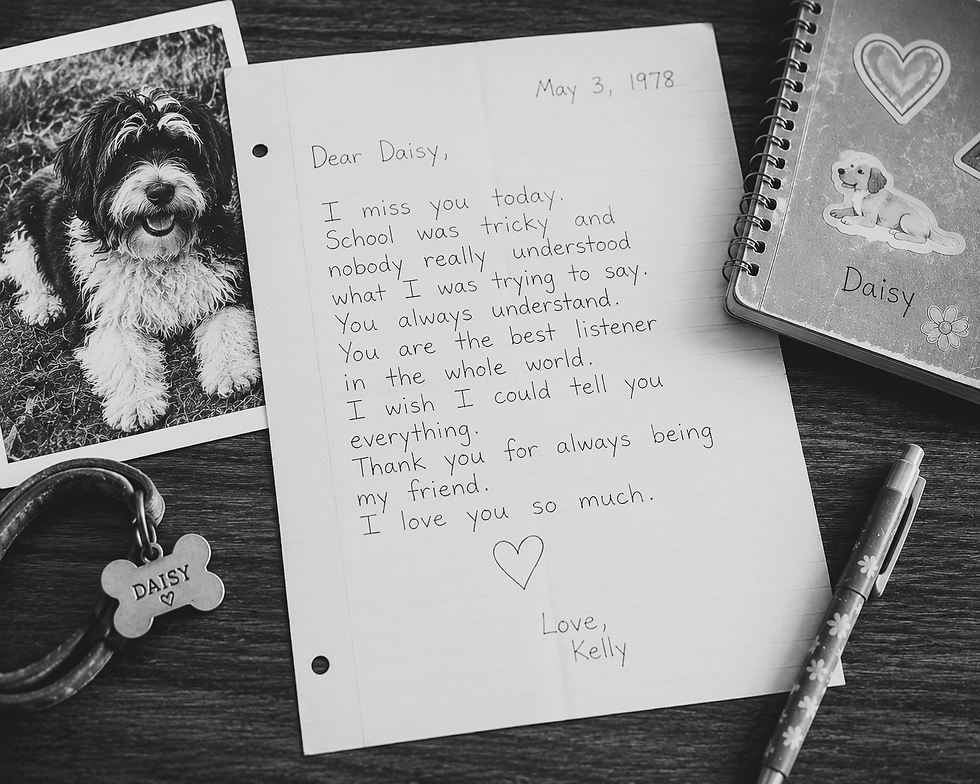
My First Journal Companion
When I was young, my journal often included letters to my dog, Daisy. A sweet black and white shaggy dog, Daisy listened, never judged, never interrupted, and never told me what to do.
She simply existed as a safe place for my thoughts.
Over time, journaling itself became that safe place.
Many years later now, I still believe that is one of the greatest gifts a journal offers.
A journal can be your friend.
Your listener.
Your confidant.
Your witness.
The Page Safely Keeps the Thoughts
Talking to friends and therapy can be helpful, but these conversations move quickly. Good ideas disappear, and emotions take over. People interrupt and agree with us when they should challenge us. Or, they challenge us when what we really need is space.
Journaling is different. A journal page:
safely keeps the thoughts.
does not join your bandwagon.
does not argue.
The page simply holds your thinking until you are ready to revisit it. Many times I have gone back to old journal entries and thought, What was I thinking? Other times I discover an idea worth exploring further. A solution I could not see at the time. A question I was not ready to answer.
The journal preserves those moments and becomes a keeper of good thinking and a guardian of meaning.
The page safely keeps the thoughts.
What Research Says About Journaling
Long before journaling became popular on social media, researchers were studying what happens when people put their thoughts and experiences into words. One of the pioneers in this area is James Pennebaker, a psychologist whose work on expressive writing helped change the way many people think about journaling.
As a college student, I stumbled across one of his research articles while searching for a topic for an abnormal psychology paper.
At the time, the idea that writing could influence emotional or physical well-being sounded almost too simple to be true.
I remember proposing the topic to a professor who laughed and essentially challenged me to prove it.
That challenge led me down a path of reading research that has influenced my teaching for decades.
Over the years, I have also been influenced by Kathleen Adams and her work in journal therapy. Her books and workshops helped me understand that journaling is not one technique. There are dozens of approaches to the page, including lists, letters, dialogue writing, stream-of-consciousness writing, and visual journaling.
What I find most compelling is that both the research and my classroom experience point in the same direction.
Writing helps us:
slow down
notice
make connections
Writing helps us process experiences that might otherwise remain tangled in our minds.
What Messy Journaling Actually Looks Like
If you picture journaling as a candle-lit desk and a beautiful leather-bound journal, you may be disappointed. Or relieved. I journal everywhere:
On airplanes.
On trains.
On cruise ship balconies.
In my dad's old leather chair.
Outside, beneath my reading tree.
On hiking trails with a weather-resistant field notebook.
Sometimes I write in an A5 traveler's notebook tucked into a leather cover.
Sometimes I write on Post-it notes.
Sometimes I write grocery lists beside reflections about life.
Many people search for journaling prompts because they worry they will not know what to write about. In reality, the world is full of prompts if we learn to pay attention.
One day I may write about a wren building a nest inside a tiny nook on our deck beside the lake. Another day I may write about grief, a student, a dog, a question I cannot answer.
Some pages are thoughtful, others angry scribbles. Some pages have airline tickets tucked between or doodles. Each journal develops its own personality.
A journal does not have rules.
The Student Who Thought His Story Was Ordinary
One student I worked with was struggling to write his college application essay for Stanford University. He insisted he had nothing interesting to say. As we talked and journaled, a different story emerged. Here are few stories he shared with me:
His family had lost their home during a hurricane.
He described his father staying behind to save what he could.
He described neighbors gathering around his mother as she cried over family heirlooms.
As I listened, I heard him describe loss, resilience, fear, community, and hope. Yet he had never considered these experiences meaningful enough to write about. Why? Because he lived them and they felt ordinary to him.
Journaling helped him discover something important:
The stories that shape us often feel ordinary because we carry them every day.
Why I Wish Every College-Bound Student Kept a Journal
Every year, I work with high school juniors and seniors preparing for college applications.
Almost all of them make the same mistake.
They assume that when it is finally time to write their college essay, they will simply sit down and write it.
College essays are not really writing assignments.
They are thinking assignments.
Students are asked to explain who they are, what they value, what they have learned, how they have changed, and why those things matter.
That is difficult work, because, like writing itself, reflection is a skill. Students may feel incapable of journaling, but they can do it.
Strong college essays rarely begin as essays. They often begin as journal entries, lists, observations, questions, and reflections collected over months or years.
Students tell me they have no stories.
What they usually mean is they have never spent enough time listening to themselves. Journaling teaches students to notice, to reflect, to make meaning. And, that is exactly what strong college essays require.

Journaling Is Executive Functioning in Disguise
There is another reason I wish more students journaled before college. Executive functioning.
Students spend their days constantly switching contexts, which we have learned can be tiring:
Biology.
Math.
English.
Sports.
Work.
Family responsibilities.
Friends.
College applications.
Scholarships.
Social media.
The brain is constantly changing channels and many students do not realize how exhausting this is. A journal gives those thoughts somewhere else to live.
I often tell students that their brains are wonderful places for having ideas but not always the best places for storing them.
As a student success coach, I often see journaling accomplish what expensive planners and productivity systems cannot. It gives students a flexible place to think.
Writing things down creates space.
Space to think.
Space to focus.
Space to breathe.
The journal becomes more than a notebook.
A journal becomes a coach, listener, planner, and a thinking partner.
Start With a List
If you are looking for journaling prompts but feel overwhelmed by long prompt lists, start simpler. Start by creating lists of your own. My favorite is called the What If? List.
At the top of a page, write: What if...
Then keep going:
What if Snickers bars were healthy?
What if I had a million dollars?
What if my mother were still alive?
What if I get into the college of my dreams?
What if I am worthy?
What if I am already enough?
Some questions will be silly, some will be profound, and this is the point. You are opening doors.
You are giving your brain permission to wander.
Who Benefits Most from Journaling?
While almost anyone can benefit from journaling, I most often recommend it to:
Students with anxiety
Students struggling with executive functioning
Overwhelmed parents
Creative thinkers
People navigating grief
High school seniors
First-year college students
Anyone experiencing a major life transition
These are people carrying too much in their heads.
A notebook gives those thoughts somewhere else to live.

The Lost Art of Traveling Journals
One practice I wish more families would embrace is the traveling journal. During my tumultuous teen years, my mother and I kept one.
Here is the process:
A parent writes. A child writes back, and the journal moves between them. Back and forth. There are no interruptions, raised voices, no pressure.
Just thoughtful communication.
I have also seen the power of handwritten letters for college students living far from home. There is something magical about receiving a handwritten letter compared to an e-mail landing in an overcrowded inbox.
Handwritten and mailed says:
You matter.
You are remembered.
You are loved.
Sometimes a traveling journal is not a journal at all. Sometimes it is simply a letter folded into an envelope with a stamp.
Trust Yourself
If there is one thing I hope readers take from this article, it is this: Trust yourself.
Many people believe they need a journaling method before they can start journaling. In my experience, the opposite is true. The method often reveals itself after you begin.
You are developing your own unique method.
Trust yourself to write about the morning cup of coffee.
Trust yourself to write about grief.
Trust yourself to write about dogs, memories, fears, hopes, and grocery lists.
Trust yourself to write badly.
Trust yourself to write imperfectly.
Trust yourself to begin.
Because journaling is not about creating something for other people, you can be brave, fierce, and vulnerable while creating a conversation with yourself.
Good writing begins with bad writing.
Frequently Asked Questions About Journaling
What if I do not know what to write about?
Start with a list. Begin with "What if..." and follow your curiosity.
Can journaling help with anxiety?
Many people find journaling helpful because it gives worries and thoughts somewhere to go rather than carrying them mentally.
How long should I journal each day?
Five to ten minutes is plenty. Consistency matters more than duration.
Do I need a fancy journal?
No. The best journal is the one you will actually use.
Can journaling improve writing skills?
Absolutely. Journaling builds writing fluency, confidence, reflection skills, and creative thinking.
Is journaling helpful for college students?
Yes. Journaling can help students manage stress, strengthen executive functioning skills, reflect on their experiences, and uncover meaningful stories for college essays.
About the Author
Kelly Thompson-Anthony
Ms. Kelly is a college writing professor, college essay coach, and founder of Write Well Academy, where she helps high school and college students develop authentic voice, strengthen writing confidence, and navigate the college application process through personalized writing support.
With years of experience teaching college-level writing and working one-on-one with students, Kelly specializes in college application essays, expressive writing, AP English preparation, and reflective writing instruction. Her approach emphasizes critical thinking, meaningful storytelling, revision, and helping students discover that strong writing begins with honest reflection rather than perfection.
Kelly’s work is grounded in the belief that writing is more than an academic skill. Writing can help students process experiences, clarify ideas, build confidence, and better understand themselves and the world around them. Through journaling, reflective writing, and individualized coaching, she encourages students to move beyond formulaic writing and develop thoughtful, authentic communication skills that extend far beyond the college admissions process.
In addition to supporting students directly, Kelly creates educational resources for parents, homeschool families, and student writers focused on college essays, writing development, and writing as a tool for growth and self-expression.
Sources and Works Consulted
The ideas in this article are informed by a combination of personal journaling practice, professional experience as a writing coach and professor, and the work of researchers, writers, and educators who have shaped my understanding of expressive writing.
Books
Writing Down the Bones by Natalie Goldberg
The New Diary by Tristine Rainer
A Life's Companion: Journal Writing as a Spiritual Practice by Christina Baldwin
The Year of Magical Thinking by Joan Didion
Research and Scholarship
Organizations
Professional Influences
More than twenty years of teaching college writing and composition
Work with high school and college students on writing confidence, reflection, executive functioning, and college application essays
Daily journaling and expressive writing practice
Conversations with students, parents, educators, and writers over the course of my teaching career
Additional Recommended Reading
If this topic interests you, I also recommend exploring:
Morning Pages Journal and The Artist’s Way by Julia Cameron's
Expressive writing research by James Pennebaker
Journal therapy techniques, The Journal to The Self, by Kathleen Adams
The role of focused attention and deep work in learning and thinking through the work of Cal Newport
Memoirs and diaries by writers such as Joan Didion and Anaïs Nin
Disclosure: Some links below are affiliate links. As an Amazon Associate, I earn from qualifying purchases at no additional cost to you. I only recommend books and resources I genuinely use, love, or believe will benefit students, parents, and writers.
Before You Go
Do not overthink this.
Grab a piece of paper. Any piece of paper.
Write five "What If?" statements. That is enough.
You do not need a perfect journal.
You do not need a perfect prompt.
You do not need a perfect writing process.
You only need to begin.
The page will meet you where you are.
And if you are curious about journaling, expressive writing, brainstorming college essays, or helping a student build writing confidence, send me an email.
Click the button below. I would love to hear what you discovered on the page.



Comments